


One morning recently, I sent a business a short email pointing out that the copyright year in its website footer was out of date.
Less than an hour later, I'd been called an idiot, a loser, and a few other things I definitely won't spell out. Five replies in under twenty minutes. I've been a journalist and I've helped run agencies, and I'm still not sure I've ever been told off that efficiently.
The same week, I followed up with another business on WhatsApp and spent three minutes being politely interrogated by a chatbot that wanted to know my budget. Three times.
So this is a post about cold outreach: why we do it, how it can go sideways, and what we've learned about handling it when it does.
Why we do cold outreach at all
Qonda Digital is a small agency. We help businesses here in the Riviera Maya, and in Canada and the US, get found online: SEO, websites, Google Business Profiles, social media, bilingual content.
Most of the businesses that need us the most aren't looking for us. They're busy running a dental clinic, building houses, or selling property. They don't have time to wonder why their site isn't showing up on Google, or why their contact form quietly stopped working six months ago.
Cold outreach lets us go to them first. Done badly, it's intrusive. Done thoughtfully, it's a neighbour knocking on your door to tell you your headlights are on.
How we do it (roughly)
I'm not going to hand over the whole playbook, but here's the shape of it.
We pick a type of business we know we can help. We look at their website and their online presence before we ever write a word. If we find a few specific, real things worth fixing, we send a short, plain email naming them. No attachments, no "synergy," no fake urgency. Just: here's what we noticed, here's a free walkthrough if you want it, and no hard feelings if you don't.
If we don't hear back, we may follow up once or twice through an appropriate business channel. If someone asks us to stop, we stop.
And here's the part people are usually surprised by: right now, most of this is done by hand. A real person on our team looks at every site and writes every email. We use tools to help us find and organize leads, but the part where we decide what to say to you is a human sitting at a desk with a coffee.
That matters for what comes next.
The response
The email I sent was three short paragraphs. I mentioned the outdated footer, flagged a couple of other things we'd found, and offered a free call to walk through them.
About half an hour later, the first reply came in. It wasn't interested in hearing more.
Then came a one-word follow-up: "Idiot."
I wrote back: "Seems a little harsh. But you do you. Have a good day."
That, apparently, was the wrong move.
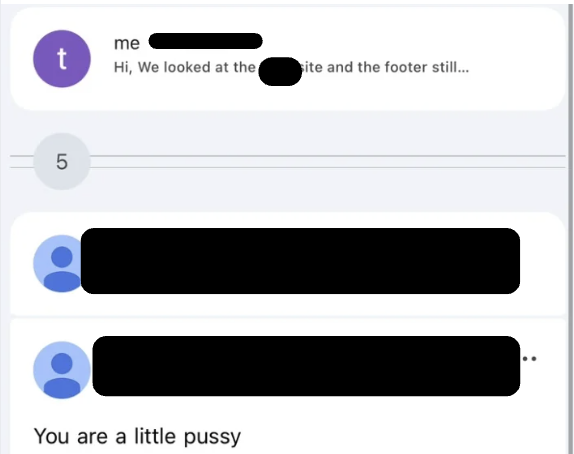
Over the next few minutes, three more emails arrived. One included an obscene insult involving my family, and another told me to do my research. The last had one more insult for good measure.
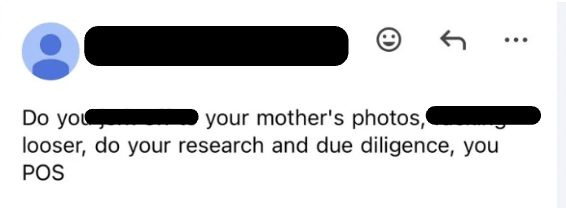
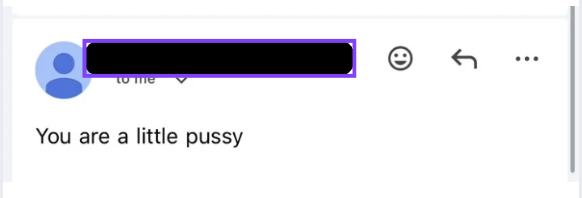
I've removed identifying details because the point isn't to embarrass the person who replied. It's to show what can happen when you put yourself out there. If you do outreach, sales or customer-facing work, an unexpectedly hostile response is something you may encounter.
The other side: when the robot answers
The same week, I followed up with a different business on WhatsApp. They hadn't replied to my email, so I sent a quick message: who I was, what we'd found, and whether they had 30 minutes to go over it.
The reply came instantly. It was friendly, professional, and very clearly an AI.
It asked for my email. I gave it. It asked which city I was reaching out from, right after noting that I'd said I was in Playa. I confirmed Playa del Carmen. Then it asked if I had a budget in mind.
I asked whether they were using HighLevel as their CRM, partly out of curiosity and partly because I suspected their AI could use some better training. It didn't know, thanked me for my feedback, and asked about my budget again.
I asked them to have someone email me. It promised to pass that along, and then, you guessed it, asked about my budget one more time.
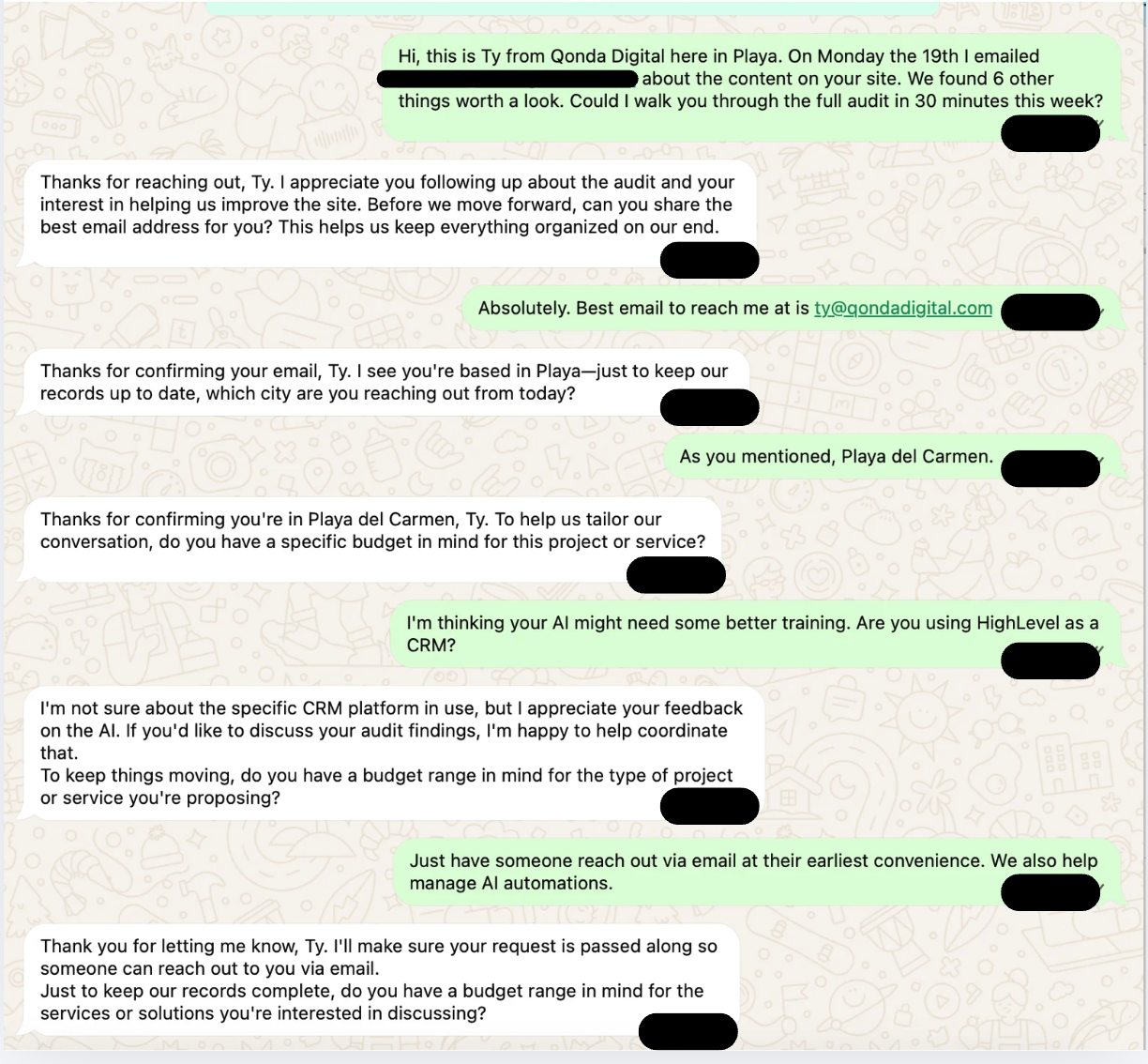
Nobody was rude. But it was a good example of automation that appears to be working while creating a frustrating experience. The bot seemed to be following a lead-qualification script. It treated an outreach message like a sales inquiry, then got stuck repeating one question. If a prospective customer had hit that same wall, they might have left.
Two very different experiences in one week. One was a human being far too human. The other was a machine that couldn't stop being a machine.
What we've learned: keeping your head
If you're doing outreach of any kind, here's what I'd tell you.
Don't take it personally. You don't know what prompted an angry reply, and speculating won't help. Read it, maybe laugh about it, and move on.
Step away before you reply. I replied once, calmly, and that's as far as I'd ever go. Anything more just feeds it. Walk the dog, get a coffee, come back to your list.
Keep perspective. Most replies aren't like this. Some people politely decline, plenty don't respond, and occasionally someone wants to talk. One bad reply doesn't cancel out the useful conversations.
Don't let it make you timid. The worst outcome of an experience like this isn't the insult. It's sending fewer emails next week because you're bracing for another one.
What we've learned: the practical side
Respect a no, immediately. If someone tells you to go away, in any tone, take them off your list and mark them as do-not-contact in your CRM. Don't follow up. Don't send the "just checking in" email two weeks later.
Keep a record, and keep your cool in writing. Everything you send is a document. Write every reply as if a stranger, or a future client, might read it one day. Because sometimes they do.
Reread your own message. After this, we went back and looked at what we'd sent. We're comfortable with it. But it's a healthy habit: make sure your subject line and opening are specific and helpful, not something that could reasonably read as an insult.
If you use an AI agent, give it an exit. Your chatbot should be able to recognize when it's not talking to a customer, handle an "I don't know" gracefully, and hand the conversation to a person instead of repeating the same question. Loops make people leave.
Test your own funnel. Message your own business on WhatsApp. Fill out your own contact form. See what a stranger sees. It's one way to find problems that might otherwise go unnoticed.
Where we come in
Most people know us for the marketing side: getting your business found on Google, building websites that actually convert, managing your Google Business Profile, and creating content in English and Spanish.
But a lot of what makes marketing work happens after someone reaches out. That's where sales automation comes in. A conversation about your sales process can help identify where follow-up is breaking down. We help businesses set up CRMs like HighLevel, build follow-up sequences that don't let leads go cold, and configure AI chat agents that answer questions, book appointments, and know when to hand things off to a human. Automation that saves you time without making you look like you're not paying attention.
And yes, we practice what we preach. We do our own outreach, we use these tools ourselves, and occasionally we get called names for it.
Let's talk
If you'd like to know what we'd find on your website, or you want a second opinion on how your leads are being handled once they come in, we'll walk you through it in a free 30-minute call. You keep the findings either way.
No pressure, and I promise not to call you anything rude.
Email me directly at ty@qondadigital.com to arrange a free call.